
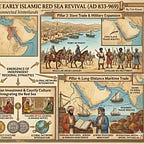
The scholarly discourse surrounding the Red Sea region has long been dominated by the narrative of Fatimid primacy, suggesting that significant economic prosperity and sophisticated trade networks only truly flourished under their rule from the late 10th century onwards. However, a compelling and meticulously researched article by Tim Power, published within the proceedings collection Connected Hinterlands, powerfully challenges this established view. Power presents persuasive evidence for a dramatic commercial growth that occurred much earlier, specifically between AD 833 and 969, an era that can be rightfully characterized as a “Red Sea Renaissance.”
This paper seeks to expand upon the core arguments presented in Power’s work, delving deeper into the historical context and the specific catalysts that propelled this remarkable, albeit long-overlooked, economic revival. By moving beyond the Fatimid-centric model, we can gain a more nuanced and accurate understanding of the dynamics that shaped the Red Sea as a critical maritime and economic artery in the early medieval period.
Follow the story along here.
A Revisionist History: Beyond the Fatimid Shade
For decades, the dominant historical narrative relegated the pre-Fatimid era in the Red Sea to a period of relative stagnation or, at best, a fragmented precursor to the ‘golden age’ that was to come. Power’s work is part of a broader revisionist movement that actively seeks to reclaim and illuminate the significance of earlier centuries. He argues that this focus on the Fatimids has inadvertently obscured a vibrant period of commercial activity and regional integration that was not dependent on their subsequent empire-building.
The time frame under consideration, AD 833-969, corresponds to a period of decentralization within the wider Islamic world. The unified Abbasid Caliphate, centered in Baghdad, was facing internal fragmentation and the rise of autonomous regional powers. While this may have weakened the absolute control of the Caliphs, Power suggests that it paradoxically created the space and impetus for a different kind of growth: one driven by localized ambition and independent Muslim states.
The Catalysts of Growth: Paving the Way for Revival
This Red Sea Renaissance was not a monolithic event but rather the culmination of several interrelated factors, many of which can be traced back to the proactive policies and economic interests of these newly independent Muslim dynasties, particularly in Egypt and Yemen. These dynasties, though potentially rivaling each other, found a common interest in securing and capitalizing on the Red Sea trade routes.
Several key developments were instrumental in fueling this pre-Fatimid boom:
A Resurgent Mining Industry: The Foundations of Wealth
A crucial pillar of this early economic revival was a resurgent mining industry, which provided the essential resources for coin production and further commercial activity. Power points to a deliberate and concerted effort by these regional states to restart or expand mining operations. The procurement of precious metals, particularly gold and silver, was paramount, as it formed the basis of the currency that facilitated increasingly large-scale and long-distance transactions.
This wasn’t just a haphazard resurgence; it involved significant investment in infrastructure and technology. The reopening of old mines, likely dating back to the Roman or even Pharaonic periods, and the exploration for new deposits required substantial state support. This organized approach speaks volumes about the strategic importance placed on securing a steady supply of bullion, and it provides a concrete example of the active state involvement that underpinned this commercial growth.
The Expansion of the Slave Trade: A Commercial Engine, A Human Tragedy
While a grim and deeply problematic aspect of this historical period, the expansion of the slave trade was undeniably a significant, albeit tragic, driver of commercial activity. The demand for labor was multifaceted, spanning agricultural, domestic, and crucially, military sectors. The regional dynasties, in their efforts to consolidate power and secure their borders, required significant numbers of soldiers, and military slavery became a prominent feature of the era.
This trade was not just a localized phenomenon. It connected the Red Sea basin to much wider networks extending into the interior of Africa and across to the Arabian Peninsula and beyond. The profits generated from this trade were substantial, and they flowed into the coffers of both the regional states and the private merchants who facilitated the transactions. It is crucial to acknowledge the immense human suffering that this trade entailed, and to understand that it was woven into the very fabric of the early medieval Red Sea economy, however deeply uncomfortable that reality might be.
A Thriving Textile Market: Threads of Commerce and Connection
A more benign, but equally important, factor was the development of a sophisticated textile market. This was not merely the trade of raw fibers but rather a highly developed industry involving the production, finishing, and trade of luxury fabrics and finished garments. This market extended beyond simple necessity, catering to the demands of the wealthy and socially striving in major urban centers.
Egypt and Yemen emerged as key players in this intricate textile network. Egypt, already famed for its high-quality linens, expanded its production, potentially incorporating new techniques and designs influenced by broader Islamic aesthetics. Yemen, too, developed its own distinctive textile traditions, particularly in weaving and dyeing.
The trade in textiles was not just about economic profit; it was a powerful force for cultural exchange and regional integration. The movement of styles, patterns, and production techniques along the Red Sea routes fostered a sense of shared material culture, creating a common language of fashion and status that connected diverse communities. This intricate and highly developed market provides a clear counterpoint to any perception of pre-Fatimid commercial life as rudimentary or isolated.
The Migration of Expertise: Iraq, Iran, and the Birth of a Global Network
Perhaps the most significant and transformative development of this era was the large-scale migration of mercantile expertise, particularly from the regions of Iraq and Iran. The long-standing, sophisticated, and vastly experienced mercantile classes from the heartlands of the Abbasid and Sasanian Empires found themselves increasingly marginalized by the political instability and economic shifts within their home regions.
Drawn by the promise of opportunity and relative stability offered by the newly independent Red Sea states, these experts brought with them an invaluable store of knowledge. They possessed expertise in navigation, shipbuilding, complex accounting methods, and critically, deep-seated connections to long-established international trade routes. Their arrival in the Red Sea basin was not just an infusion of labor; it was the transplantation of a complete mercantile operating system.
Their influence was transformative. They integrated the hitherto relatively localized Red Sea trade into a vast, interconnected network that extended as far as India and even China. Suddenly, the Red Sea was not just a regional artery; it was a critical link in a nascent global economy. Goods from East Africa, Yemen, and Egypt could be seamlessly transported across the Indian Ocean, finding eager markets in distant empires. This was the defining moment of the Red Sea Renaissance, the moment when it truly transcended its regional boundaries and became a vital player on the world stage.
Reconsidering the Red Sea: Implications and Unanswered Questions
The evidence presented by Power, when viewed collectively, paints a picture of a vibrant, interconnected, and economically sophisticated Red Sea region well before the Fatimids established their dominance. This has significant implications for our understanding of several key aspects of early medieval history:
The Decentralization of Power: It demonstrates that political fragmentation within the wider Islamic world did not necessarily lead to economic collapse. Instead, it seems to have spurred localized competition and the rise of new, dynamic centers of commerce, often driven by the ambition and economic interests of independent regional dynasties.
State and Economy: It highlights the active role that even ostensibly weak or short-lived regional states could play in fostering economic growth through strategic investments in infrastructure and the promotion of trade.
The Movement of Knowledge: It provides a compelling case study for the crucial role that the migration of skilled individuals and expert knowledge can play in transforming a regional economy and integrating it into wider, international networks.
While Power’s work provides a compelling framework for understanding this “Pre-Fatimid Renaissance,” it also raises several important questions that merit further scholarly investigation:
The Role of Non-Muslim Communities: To what extent did Christian, Jewish, and other non-Muslim communities participate in or were affected by this economic boom? Their presence in the Red Sea region was well-established, and their contributions to trade and cultural exchange need to be more fully explored.
The Long-Term Legacy: How did this pre-Fatimid commercial structure shape the subsequent developments under Fatimid and Ayyubid rule? Was there a direct continuity, or were there significant shifts and changes?
Environmental Impact: What was the environmental impact of increased mining activity, shipbuilding, and the growth of urban centers along the fragile coastlines of the Red Sea? This is a crucial question in the context of medieval environmental history that is only now beginning to be addressed.
Conclusion
Tim Power’s meticulous and insightful analysis of the Red Sea region between AD 833 and 969 has decisively dismantled the narrative of Fatimid-centric economic dominance. The evidence he marshals clearly demonstrates that this earlier era, far from being a period of stagnation, was a time of remarkable commercial vitality, regional integration, and global connectivity.
This “Red Sea Renaissance” was not a fluke but the outcome of specific historical forces: the proactive policies of independent Muslim states, a resurgent mining industry, the (deeply problematic) expansion of the slave trade, a sophisticated textile market, and most critically, the migration of mercantile expertise that integrated the region into a truly global network.
By pushing beyond the convenient historical boundaries of empire, we are beginning to unearth the complexities, dynamics, and deep-seated connections that made the pre-Fatimid Red Sea a critical crucible of economic and cultural exchange. This work is not just a footnote to the Fatimid story; it is a fundamental revision that forces us to reconsider the entire narrative of early medieval commerce and to recognize the resilience, ingenuity, and interconnectedness of the societies that shaped this vital maritime world.


