
TL;DR:
To establish Ashramization as a formal historiographical tool, we must define it as the systematic process of Preservation via Caricature. Unlike Damnatio Memoriae, which is a "Delete" command, Ashramization is a "Rename and Reformat" command. It ensures the predecessor remains in the collective memory, but only as a scarred, diminished, or "glitched" version of themselves to justify the "patch" or "upgrade" provided by the successor state.
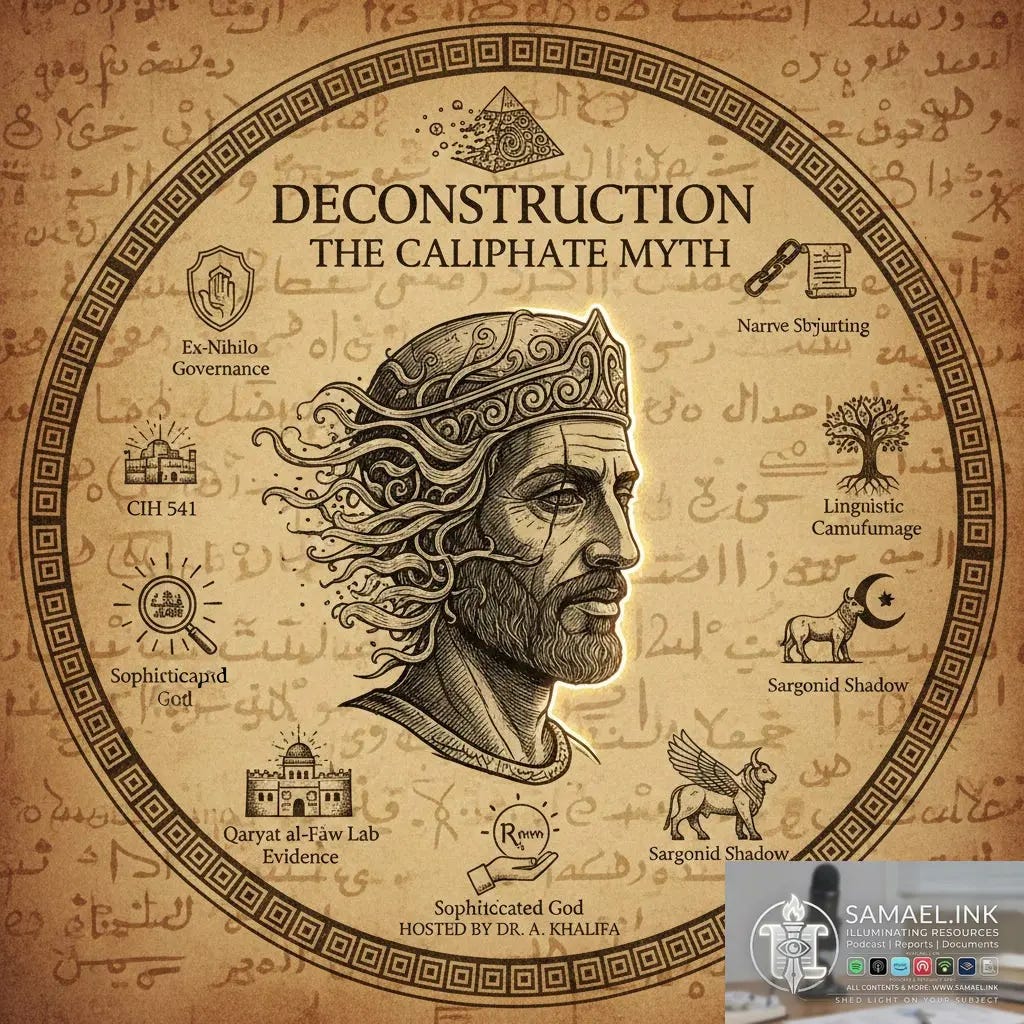
Formal Definition: Ashramization
Ashramization (n.): A historiographical operation where a predecessor’s administrative, legal, or religious innovations are "harvested" by a successor state while the predecessor’s personhood is simultaneously reduced to a singular physical or psychological defect (the "Scar"). This ensures the Operating System remains functional while the Engineer is delegitimized.
Key Components of the Ashramization Process
The Harvest: Identifying the "Operating System" elements—titles like ḫlft (Khalifa) or concepts like Rḥmnn (Ar-Rahman)—that are too integrated into the local population to be deleted.
The Scarring (The Ashram): Selecting a specific vulnerability—a literal scar (Abreha), a mutilation (Justinian II), or a behavioral eccentricity (Akhenaten)—and making it the "anchor" of their identity.
Narrative Subjugation: Placing this scarred figure at the center of a "failure narrative" (e.g., The Year of the Elephant). The figure is not erased; they are made the antagonist in a story where the successor state is the inevitable, "healed" hero.
Linguistic Camouflage: Reframing the predecessor's sophisticated titles as primitive or "proto" versions of the successor’s "pure" language.
Categorizing Other "Ashramized" Figures
If we apply the framework, several figures in history move from "misunderstood" to "Ashramized":
Justinian II: The Rhinometos (Slit-Nosed) Protocol
The OS: He attempted to implement a revolutionary legal system that protected the eleutheroi (free peasants) from the land-grabbing aristocracy.
The Ashram: The slitting of his nose in 695 CE.
The Result: Byzantine history remembers the "Mutilated Madman" with the golden nose, successfully "dirting out" the fact that his administrative reforms were so effective that the Empire survived the 7th-century collapse because of them.
Akhenaten: The Anomaly Protocol
The OS: A radical centralization of state resources and a move from "God-napping" (local deities) to a universalist monotheistic bureaucracy.
The Ashram: The "Effeminate" or "Alien" physical depictions in Amarna art.
The Result: Rather than being seen as a cold, calculating political reformer, he is Ashramized into a "Dreamer" or a "Physically Deformed Heretic," allowing the 19th Dynasty to keep his centralized power structure while publicly disavowing his "madness."
The Semitic Root Context
The term itself draws from the Arabic root Š−R−M (ش-ر-م), found in al-Ašram (Arabic: الأشرم, romanized: al-Ashram, lit. 'the one with a slit lip/nose').
In the context of CIH 541 (Sabaean: 𐩩𐩦𐩧𐩣, romanized: tšrm, lit. 'to be split/scarred'), we see the irony: the very inscriptions that prove his majesty are used as the "data source" to extract the "Scar" that would eventually define him in the Islamic Sīra.