
Full name: Abū Rayḥān Muḥammad ibn Aḥmad al-Bīrūnī
Born: September 5, 973 CE
Birthplace: Kath, the capital of the Khwarezm region (near modern-day Khiva, Uzbekistan)
Died: Around 1048 CE
Background
Al-Biruni was born in the region of Khwarezm, an important cultural and intellectual center of Central Asia. The name “al-Biruni” (meaning “the outsider” in Arabic) refers to his being from the outskirts of the city of Kath. His upbringing took place in an environment rich in learning, influenced by both Persian and Islamic traditions.
Education and Early Interests
From an early age, Al-Biruni showed an extraordinary aptitude for science and mathematics. He was trained in:
Mathematics and astronomy, which became his lifelong focus
Philosophy, medicine, geography, and linguistics
He studied under local scholars in Khwarezm and was exposed to the works of Greek, Indian, and earlier Islamic thinkers.
By his twenties, Al-Biruni had already:
Calculated the latitude of his hometown using astronomical observations.
Written his first major work on chronology, demonstrating his deep interest in the measurement of time and the movements of celestial bodies.
Al-Biruni – Works and Career
Although Al-Biruni lived centuries after the Hellenistic era, he was one of the key figures who preserved, expanded, and critically evaluated the legacy of Greek science.
By his time (10th–11th century CE), Greek thought had already been absorbed and translated into Arabic during the Abbasid translation movement (8th–9th centuries). The works of Aristotle, Ptolemy, Euclid, and Archimedes circulated widely across the Islamic world — often through centers like Baghdad, Bukhara, and Rayy.
Al-Biruni inherited this vast intellectual archive but went beyond commentary. He:
Critically examined Greek astronomical models, questioning Ptolemaic assumptions.
Integrated Indian and Persian knowledge with Greek mathematics and logic, creating a more global framework of science.
Promoted an empirical and comparative approach, emphasizing measurement and observation — not blind acceptance of authority.
In this sense, Al-Biruni represents a post-Hellenistic synthesis — where ancient Greek rationalism was fused with Islamic scientific rigor and enriched by Indian and Persian insights.
Intellectual Setting and Early Career
After his early education in Khwarezm, Al-Biruni became deeply involved in the intellectual life of the region. The Khwarezmian court was a hub for science and culture, patronized by rulers who valued scholarship.
However, political upheavals in Central Asia — particularly the expansion of the Ghaznavid Empire under Sultan Mahmud of Ghazni — led Al-Biruni to travel widely. He eventually joined Mahmud’s court in Ghazni (in modern-day Afghanistan), where he found the stability and resources to continue his research.
Fields of Study
Al-Biruni was one of the most versatile scholars of the Islamic Golden Age. His works span over a hundred treatises, covering:
Astronomy & Mathematics
He refined methods for measuring the Earth’s radius and circumference, using innovative geometric and observational techniques.
Authored “Al-Qanun al-Mas‘udi” (The Mas‘udi Canon) — an encyclopedic work on astronomy, geography, and mathematics dedicated to Sultan Mas‘ud of Ghazni.
Discussed planetary motion, eclipses, and trigonometric functions with remarkable precision.
Introduced the concept of using the radius instead of the diameter in trigonometric calculations — a method that became standard later.
Geography & Geodesy
Conducted some of the earliest accurate measurements of longitude and latitude.
Suggested that the Earth might rotate on its axis — centuries before Copernicus.
Accurately determined the radius of the Earth using triangulation from mountain heights.
Physics & Natural Sciences
Studied specific gravity and devised methods for measuring the density of various substances — a foundation for later developments in physics and chemistry.
Investigated light, heat, and mineral properties.
Chronology & History
Wrote “The Chronology of Ancient Nations”, analyzing calendars and dating systems of various civilizations — including Persian, Greek, Jewish, and Indian systems — to compare how they reckoned time.
Journey to India and Cultural Exchange
Perhaps his most famous work arose from his time in India:
Kitāb al-Hind (The Book of India)
Written after traveling with Sultan Mahmud’s campaign to the Indian subcontinent.
A remarkable ethnographic and scientific study of Indian culture, religion, philosophy, astronomy, and geography.
Unlike many travelers, Al-Biruni approached Indian civilization with intellectual curiosity and respect, striving to understand it on its own terms.
He learned Sanskrit to access original Indian texts, translating and analyzing works on astronomy, mathematics, and philosophy.
Later Life and Legacy
In his later years, Al-Biruni continued his research and writing in Ghazni, maintaining correspondence with scholars across the Islamic world.
His later works integrated empirical observation with mathematical reasoning, marking a significant step toward the modern scientific method.
Influence and Significance
Al-Biruni’s scientific precision and comparative approach earned him the title of “The Father of Indology” and one of the founders of geodesy.
His commitment to objectivity and cross-cultural understanding made him a model for modern scholarship.
Many of his astronomical and mathematical ideas influenced both Islamic and European science centuries later.
Scholarly Circles and Correspondence
Al-Biruni operated within a vibrant network of scholars stretching from Khwarezm to Ghazni, and across the broader Islamic world. Some of the most notable figures and circles connected to him include:
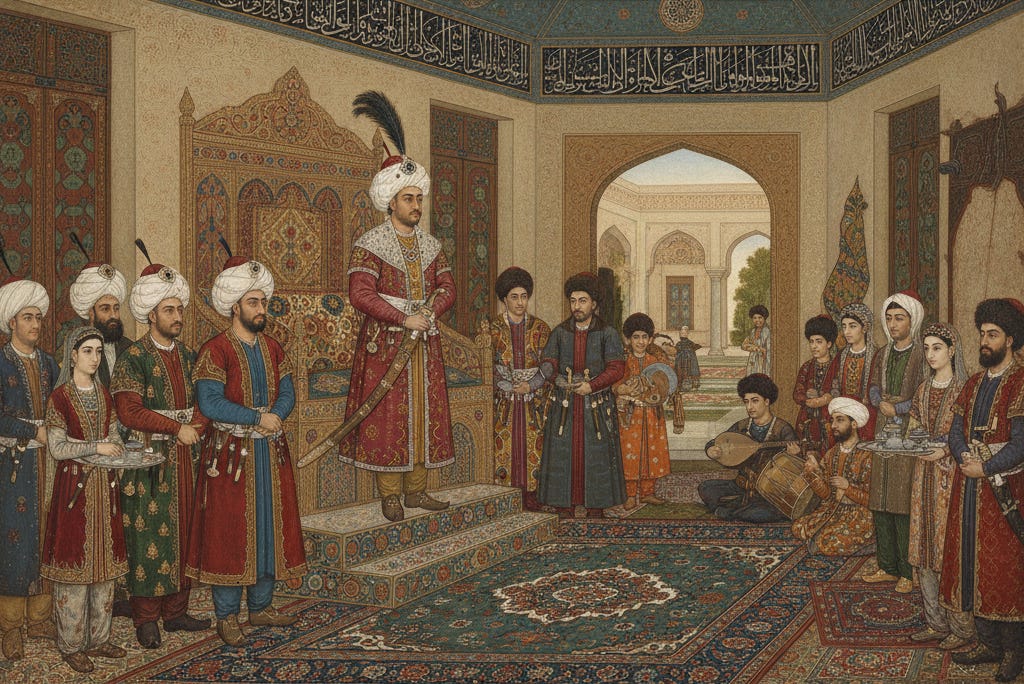
The Khwarezm Academy (Khwarezmian Court)
Before joining the Ghaznavids, Al-Biruni worked among a circle of mathematicians, astronomers, and philosophers in Kath, under the patronage of the Afrighid and Ma’munid rulers.
There, he interacted with scholars such as:
Abu Nasr Mansur ibn Iraq – a fellow Khwarezmian mathematician and astronomer who collaborated with Al-Biruni on trigonometry and geometry.
Abu’l-Wafa al-Buzjani – though based in Baghdad, his works on trigonometry and astronomy influenced Al-Biruni deeply.
The Ghaznavid Court in Ghazni
At Sultan Mahmud of Ghazni’s court, Al-Biruni found a new hub of learning. Here he corresponded with:
Avicenna (Ibn Sina) – the famed philosopher and physician. Though they never met in person, they exchanged letters debating philosophy, physics, and metaphysics.
Their dialogue remains one of the most sophisticated intellectual exchanges of the era.Scholars from India and Central Asia — whom Al-Biruni met during Mahmud’s Indian campaigns, enabling his deep study of Indian sciences and thought.
Broader Scholarly Exchanges
Al-Biruni maintained correspondence with other astronomers and philosophers across the Islamic world, often sharing observations and comparing astronomical data.
He frequently cited Ptolemy, Hipparchus, and Aristotle, but also Indian astronomers like Aryabhata and Brahmagupta, showing how widely his intellectual connections extended.
In Summary
Al-Biruni’s significance after Hellenization lies not in merely preserving Greek science, but in transcending it — combining the logic of Greece, the observation of India, and the mathematical precision of Persia.
Through his vast correspondence and participation in elite scholarly circles, he helped globalize scientific knowledge, setting a standard for rational inquiry that bridged civilizations.
This piece really made me think about Al-Biruni. It's wild to imagine such a polymath, like a human search engine without any intenet. Makes you wonder if we've lost something with modern specialization.