
Coming soon, we will be releasing a comprehensive reconstruction of the maritime “admin” that defined the Red Sea before the great 8th-century blockade. This forthcoming work will move beyond the “Mountain King” narrative to explore the sophisticated engineering and diplomatic “software” that once made the Najashi a peer to the universe’s top powers. In the 7th century, the Aksumite Empire (Ge’ez: አክሱም) functioned as a “Sacred Peer” and the primary maritime guardian of the Red Sea, held in high esteem by the Umayyad Caliphate through the Prophetic Peace of the first Hijra. This maritime "Operating Logic" moved beyond the isolationist "Mountain King" narrative, revealing a sophisticated administrative system that gave the Najashi (ነጋሲ) control over the southern waves and a "Most Favored" status in international diplomacy. By maintaining the "Transit Corridors" between the Indian Ocean and the Mediterranean, Aksum provided the essential naval architecture that secured regional stability before the 8th-century blockade permanently "dried out" this era of shared Red Sea sovereignty.
The Red Sea before the 8th-century blockade was governed by a sophisticated "Maritime Admin" that positioned the Aksumite Empire (Ge’ez: አክሱም) as a Sacred Peer to the Umayyad Caliphate. Rooted in the Prophetic Peace established during the first Hijra, this diplomatic framework ensured that the Najashi (ነጋሲ) was respected not merely as a local chieftain, but as a "Most Favored" partner with exclusive control over the southern maritime waves. This era of shared "Operating Logic" allowed for a high-stakes exchange of trade and prestige, where Aksumite naval engineering secured the regional "Transit Corridor" before the eventual blockade "dried out" the Empire's coastal influence. Ultimately, the relationship was defined by a mutual recognition of sovereignty, where the keys to the Red Sea were held by a Christian power that the Caliphate considered spiritually and politically untouchable.
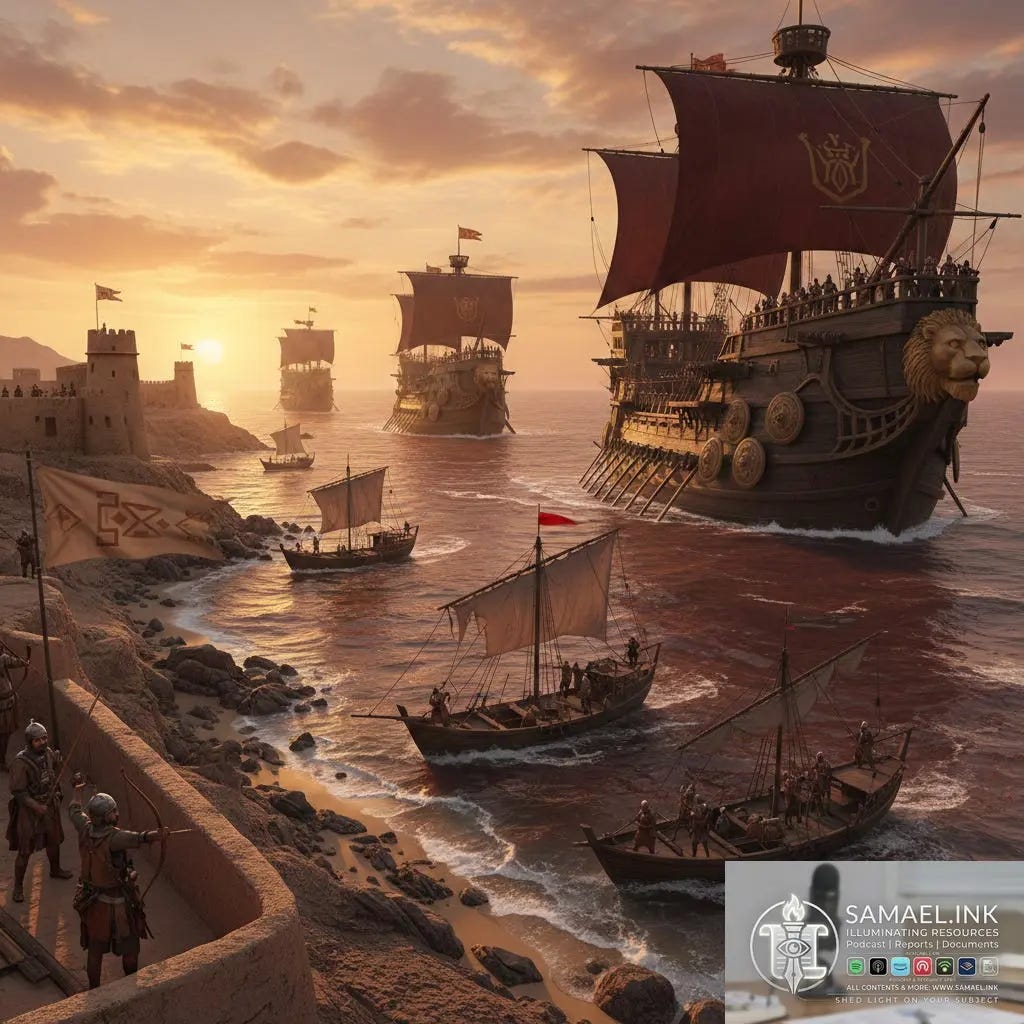
However, the 702 AD (83 AH) assault on Jeddah—the “Gateway to Mecca”—triggered a catastrophic “system crash”. This high-intensity strike caused an immediate “software” update in Damascus; the Umayyad administration re-categorized the Aksumites from “Sovereign Partners” to “Sea-Infidel Pirates” (Lusus).
The Architecture of Containment
The retribution was total. Caliph Abd al-Malik ibn Marwan issued a decree for the permanent Seizure of the Dahlak Archipelago, turning the islands into a maritime “Habs” (detention center).
The “Sewn-Plank” Requisition: Umayyad papyri from Aphrodito reveal a frantic effort to replicate Aksumite naval “hardware” using palm-fiber and coir to navigate the Red Sea reefs.
The Coastal Filter: The Caliphate utilized the coastal tribes as “wardens,” severing the logistical road between the port of Adulis and the highland capital.
The Internal Collapse: Weakened by the blockade, the empire faced the “Woman of Fire,” the Queen of Banu al-Hamwiyya, who deleted the remaining Aksumite administrative structures in the 10th century.
The Myth of the Sea-less King
By the 14th century, the Solomonic Dynasty had accepted a new, land-locked identity. They wrote the Fetha Nagast (Law of the Kings) to codify the “Forbidden Descent,” legislating that the King must remain mountain-anchored for spiritual purity. While the Kings mythologized the lost ports as a distant “Atlantis,” the people’s language—preserved in Harari and Silt’e—kept the “hardware” receipts of their seafaring ancestors alive in their technical vocabulary.
Check back soon for the full content: We are diving deeper into the Adulis Graffiti, the technical “blueprints” of the Hellenistic thrones, and the linguistic “fossils” that prove the Habasha never truly lost the sea—they were just forced to wait for a reboot.
Subscribe now to ensure you don’t miss the upcoming breakdown of the Aphrodito Papyri labor logs and the Agaw roots of the Zār spirit cult.
The traditional narrative of an unbroken northern lineage often overlooks the violent structural ruptures of the 10th century. A pivotal moment in the re-centering of the Ethiopian state was the rise of Gudit (likely the Queen of the Banu al-Hamwiyya), whose forces sacked the Aksumite capital (Gez: 𐩱𐩫𐩪𐩣, romanized: ʾksm). This upheaval forced the Aksumite royal remnants to retreat further south into the inaccessible mountainous redoubts of Amhara and Sewa.
This was not merely a military retreat but a strategic relocation of the Kəbrä nägäśt (Ge’ez: 𐩫𐩨𐩧𐩠 𐩬𐩥𐩘𐩩, lit. ‘Glory of the Kings’) ideology. The move to Kabura—the nascent political center in the south—allowed for the preservation of the Solomonic claim far from the reaching influence of Nilotic or Beja incursions in the north. This southern migration explains the linguistic “deepening” of Amharic in regions historically peripheral to Aksum. Evidence suggests a diplomatic link between this retreating elite and the Makurian King George II, indicating that the Aksumite state remained a recognized, albeit displaced, sovereign entity within the broader Christian Nile-Red Sea corridor (Munro-Hay 1991, 250).
The “Pearls for Grains” Economy: 702 CE and Beyond
Parallel to this southward shift was the isolation of the northern highlands through the Umayyad occupation of the Dahlak Islands in 702 CE. The establishment of this maritime outpost created a symbiotic but restrictive economic loop. The “Pearls for Grains” provision system forced the northern highlands (modern Tigray and Eritrea) into a role as a geopolitical buffer.
The Exchange: Coastal Arab merchants traded luxury goods and pearls for the agricultural surplus of the highlands.
The Result: This tethered the northern elite to Red Sea trade cycles while the southern Amhara regions developed a more autonomous, land-based feudal agrarianism that would eventually fund the Solomonic restoration (Tamrat 1972, 42).
A Raid That Was Never About Expansion: How Islamic Civil Wars Shaped the Aksumite Raid on Jeddah (702 CE)

TL;DR: The Aksumite raid on Jeddah in 702 CE has long been misread as an act of African imperial ambition. It wasn't. It was a reactive strike—a geopolitical intervention born from the ashes of Islamic civil war.