
TL;DR:
This article invites readers on a deep exploration of Abraha w-asbeha’s multifaceted identity, proposing that no single source or genre can fully contain his story. We begin by situating Abraha within the dense mesh of primary inscriptions, chronicles, and archaeological traces that anchor him in concrete historical inquiry. These materials—stone stelae, contemporary annals, and regional chronicles—offer the foundational facts and contested dates that scholars use to build hypotheses about his origins, political ambitions, and material legacy. Close readings of these records reveal both the certainties and the lacunae: what can be corroborated through epigraphy and what remains a matter of interpretation, translation, or conjecture. By foregrounding this documentary base, the article establishes a rigorous, source-driven framework from which other narrative strands may be critically assessed.
Layered atop the documentary record are the traditional narratives—oral histories, religious texts, and folk memories—that have preserved and transformed Abraha’s image across generations. These accounts often amplify moral meanings, cosmopolitan anxieties, and cultural aspirations in ways that official inscriptions do not; they fold Abraha into collective imaginations as conqueror, reformer, or antagonist depending on the teller’s vantage. The article traces how these stories migrate across communal boundaries, becoming refracted through different languages, ritual contexts, and literary conventions. Far from being mere embellishment, such traditions function as social mirrors, reflecting how communities remember power, trauma, and resistance. Examining these narratives side by side with epigraphic evidence exposes productive tensions: where popular memory embellishes, where it omits, and where it preserves countervailing perspectives otherwise absent from official records.
Interwoven with historical and traditional sources is the growing presence of modern scholarship, which brings methodological rigor, comparative frameworks, and theoretical lenses to the study of Abraha. Historians, archaeologists, and philologists interrogate source provenance, employ stratigraphic and numismatic evidence, and situate Abraha within broader regional histories of trade, religion, and imperial exchange. This section of the article highlights major scholarly debates—over chronology, political structure, and cultural influence—showing how new discoveries and reinterpretations recalibrate longstanding assumptions. Crucially, it also considers historiographical reflexivity: how scholars’ own contexts, disciplinary methods, and theoretical commitments shape the questions they ask and the narratives they construct about Abraha’s life and legacy.
Finally, the article addresses the provocative arrival of artificial intelligence as both tool and narrator in reconstructing Abraha’s past. AI-driven reconstructions—textual syntheses, visual reconstructions, and simulated narratives—offer unprecedented ways to aggregate fragmentary evidence, suggest plausible scenarios, and visualize lost landscapes. Yet these technological interventions carry risks: algorithmic biases, overconfident speculation, and the potential to smooth over uncertainties into coherent but misleading stories. The piece evaluates AI’s contributions and limits, arguing for a balanced approach that leverages computational power while maintaining critical human oversight and disciplinary skepticism. Bringing together inscriptions, traditions, scholarship, and AI, the article aspires to present a textured, honest account of Abraha w-asbeha—one that preserves ambiguity where it belongs and illuminates complexity where it matters.
This article was originally published on January 9, 2024.
Definition of the Problem
The Contrasting Historical Accounts of Abraha w-asbeha
Abraha w-asbeha’s identity, shrouded in the mists of time, exhibits a dichotomy that prompts a vigorous academic and cultural debate. On one hand, Geez/Sabean epigraphic documentation presents him as an Axumite sent to the Hijaz, painting a portrait of a man whose roots intertwine with the rich soil of Ethiopia. In stark contrast, later Arabic narratives sculpt a different visage, one born from Yemenite origins, christened as Abraha Al-Ashram.
The Role of Big AI and Big Money in Shaping Historical Narratives
The modern era, marked by the rapid advance of technology, witnesses an escalating influence of artificial intelligence in the domain of historical analysis. Funded by significant financial investments, big AI has become a prominent actor in the arena of narrative construction. However, the amalgamation of technological prowess and financial interests begets a potent mixture, potent enough to obscure the nuances of historical truth, and in certain instances, augment or diminish the legacies enshrined in the annals of time.
Case Study: Norbert Nebes’ Academic Work vs. AI Reconstruction
Norbert Nebes’ scholarly endeavors, epitomized in works such as the translation of a new ‘Abraha inscription from the Great Dam of Marib, tread a path that is meticulously carved through rigorous academic scrutiny and critical historical analysis. This is a path that seeks to dissipate the fog of conjecture and ambiguity. Contrastingly, AI reconstruction, imbued with the potency of algorithms and computational might, often offers a rendition of history that, while impressive in its analytical abilities, can be vulnerable to the imbued biases of its creators and the influential sway of financial undercurrents.
As we navigate through this exploration, we endeavor to juxtapose the intricate layers of traditional, academic, and AI-generated narratives. This quest is not just an academic exercise but a journey to unravel the truths that lie beneath the multifaceted representations of a historical figure like Abraha w-asbeha. In the following sections, we will dissect these layers, assessing their credibility, their contexts, and their implications for the historical, cultural, and academic landscapes that continue to shape our understanding of the past, present, and future.
Critical Historical Analysis
Historical narratives, inherently intricate and multifaceted, require a meticulous and discerning approach to unfurl the complexities and present a well-rounded account. The exercise is not just about revisiting the annals of history but decoding the subtle and, at times, overt influences that have shaped these narratives over centuries.
Explanation and Importance
Unbiased Examination of Historical Facts
Critical historical analysis underscores the necessity for an unbiased examination of historical facts. It transcends the adoption of a linear narrative, advocating for a comprehensive scrutiny that accounts for varying perspectives, contexts, and influences. This analytical approach unveils layers of history that may otherwise remain obscured, facilitating a nuanced understanding that integrates diverse narratives and interpretations.
Balancing Varying Sources and Narratives
The endeavor to balance varying sources and narratives is pivotal. Each account, whether rooted in traditional orthodoxy or reflective of revisionist interpretations, offers valuable insights. The balancing act lies in weaving these disparate threads into a cohesive narrative that, while acknowledging the inherent contradictions, strives for an inclusive, holistic portrayal of historical events and figures.
Norbert Nebes’ Contribution
A Detailed Review of Nebes’ Findings
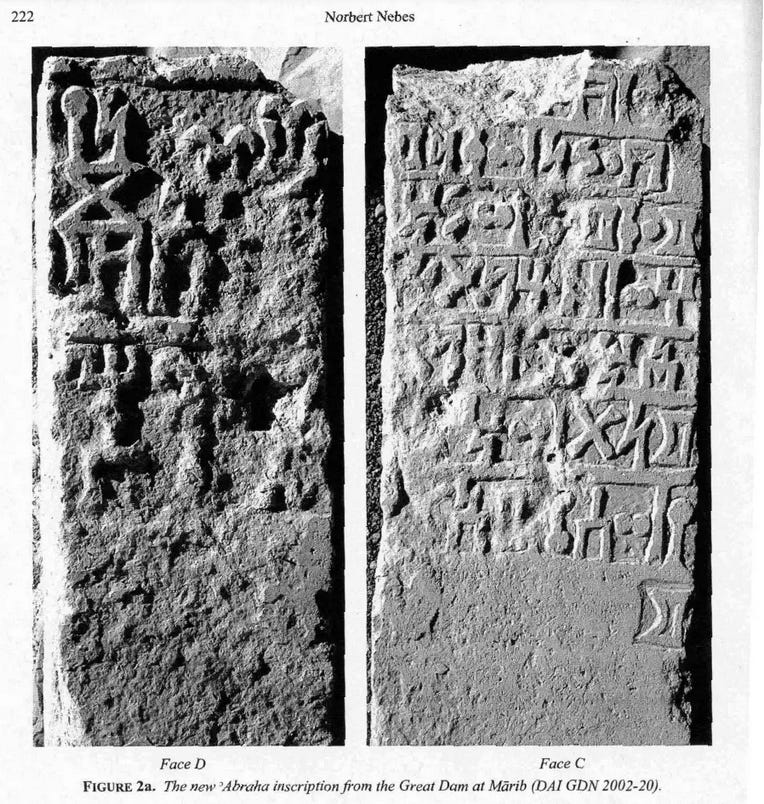
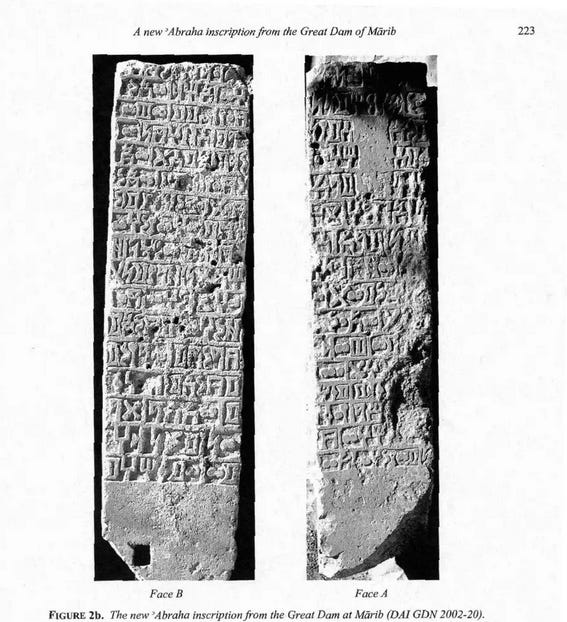
Norbert Nebes’ works, particularly his translation of the ‘Abraha inscription from the Great Dam of Marib, exemplify the potency of critical historical analysis. Nebes, with meticulous precision, navigated the intricate corridors of epigraphic documents and historical accounts, shedding light on Abraha w-asbeha’s identity amidst the juxtaposing narratives.
The Implications of Nebes’ Work in Understanding Abraha’s Identity
Nebes’ findings underscore the contention that envelopes Abraha’s identity. By revisiting and decoding ancient inscriptions, Nebes portrayed Abraha as a figure rooted in the cultural and historical landscape of Ethiopia, a narrative that starkly contrasts the later Arabic accounts. The implications of his works resonate profoundly, prompting a reassessment of entrenched beliefs and offering a platform for an enriched discourse.
Revisionists vs Traditionalists
In this rich milieu of critical historical analysis, we encounter the dynamic discourse between revisionist and traditionalist scholars.
Revisionist Scholars — The likes of Andrew Rippin, Martin Hinds, Yehuda D. Nevo, and Sven Kalisch, among others, infuse the discourse with perspectives that often challenge established narratives. Their works, characterized by a rigorous analysis and unconventional insights, compel a re-evaluation of ingrained historical accounts.
Traditionalist Scholars — On the flip side, scholars like Norbert Nebes, Gustav Weil, Ignác Goldziher, and Christopher Haas anchor the traditionalist viewpoint. Their works, deeply embedded in established narratives, provide a counterbalance, offering insights that are often aligned with orthodox interpretations.
ABRAHA: THE "GENERAL FROM WITHIN"

How did a former enslaved man and an empire-destroying queen rise to power in ancient Ethiopia, shattering the myth of rigid, inherited hierarchies?
Navigating the Dichotomy
In the context of Abraha w-asbeha, this vibrant conversation between revisionist and traditionalist scholars illuminates the multifaceted nature of his identity. Each perspective, enriched by a unique methodology and insight, contributes to a complex tapestry that defines Abraha’s historical portrayal.
As we progress, the nuanced interplay between these diverse narratives, the role of AI in shaping modern interpretations, and the imperativeness of critical historical analysis in navigating these complex terrains will be pivotal in fostering a comprehensive, unbiased, and enriched understanding of historical figures like Abraha w-asbeha.
Traditional Narratives and Epigraphic Documentations
Unearthing the multidimensional identity of historical figures like Abraha w-asbeha entails an intricate interplay of traditional narratives and epigraphic documentations. This synergy provides the nuanced layers necessary for a holistic interpretation of a persona carved by various influences throughout history.
Overview of Traditional Narratives
The Role in Shaping Cultural and Historical Identity
Traditional narratives serve as the pulsating veins that nourish the body of historical and cultural understanding. They are crafted and nurtured by the echoes of ancient voices, monumental events, and the subtle, yet profound influences of socio-cultural dynamics. These narratives, imbued with an essence that transcends the chronicles of time, provide not just a recount of historical occurrences but an immersive experience into the worlds long past.
Influence on the Perception of Historical Figures like Abraha
In the enigmatic landscape of Abraha w-asbeha’s existence, traditional narratives act as the brushstrokes painting his character, actions, and legacy. They weave a complex tapestry that amalgamates the tangible and intangible, offering a depiction of Abraha that is as reliant on the explicit recounting of events as it is on the implicit cultural, social, and political undertones of the era.
Epigraphic Evidence from the Hijaz
A Comprehensive Exploration of Geez/Sabean Epigraphic Documents
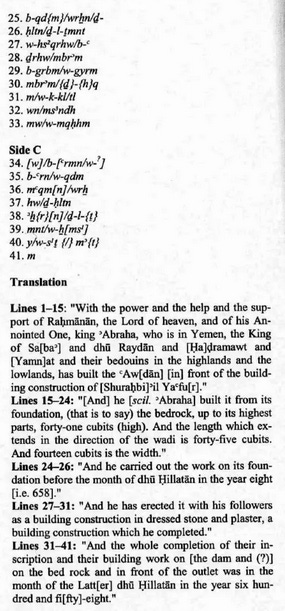
While the Sabean inscriptions, particularly those highlighted by Norbert Nebes in his revealing study, offer an unprecedented window into the realm of Abraha’s existence, the Geez inscriptions too, found in the same region at various times, hold intrinsic value. Nebes’ interpretation of the Sabean inscriptions from the Great Dam of Marib unfolds a narrative intricately woven with elements that both align and conflict with established Arabic and Ethiopian perspectives.
Their Role in Corroborating or Challenging Arabic Narratives
These epigraphic relics are more than etchings in stone; they are dynamic testimonials breathing life into the cold, often impersonal, annals of history. The Sabean inscriptions, replete with the delicate nuances of a civilization and epoch expressed in every carve and curve, offer revelations that are instrumental in validating or refuting existing narratives. Simultaneously, the Geez inscriptions, though distinct, contribute an additional layer of depth, enriching the discourse with perspectives that transcend unilateral viewpoints.
Every epigraphic document, each inscription, whether Sabean or Geez, is a voice echoing the narratives, beliefs, and identities of the people and epochs they represent. They play a pivotal role in either corroborating or challenging established Arabic narratives, ushering in an era of enhanced understanding, marked by a dynamic interplay of perspectives that are as diverse as they are insightful.
In the grand dance of history, where traditional narratives and epigraphic documentations waltz to the timeless tunes of epochs past, a multi-dimensional image of figures like Abraha w-asbeha emerges — a depiction not confined by the linear constructs of time but enriched by the complex, intricate, and profound influences that have journeyed through the corridors of history to greet the present in all their enigmatic splendor.
AI’s Revisionist Reconstructions
In the vast and intricate landscape of historical narrative construction, artificial intelligence emerges as a formidable player, endowed with the capacity to sift through colossal data sets and unveil patterns and interpretations that are often beyond the reach of human analysis. However, this technological marvel is not without its own set of challenges and controversies.
Explanation of the AI Revisionist Approach
The AI’s Account of Abraha al-Ashram’s Origin and Identity
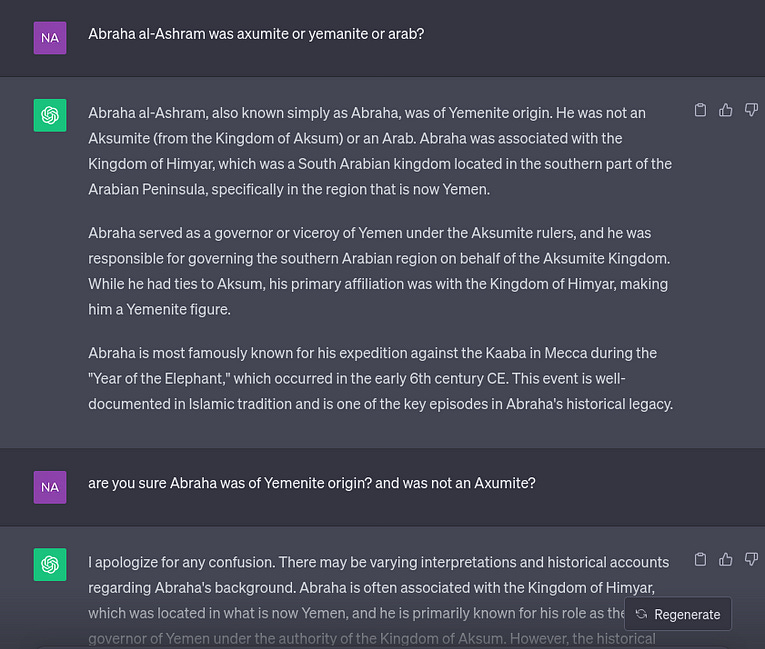
In the context of Abraha w-asbeha, AI’s reconstruction presents a depiction that is notably distinct from both the traditional narratives and epigraphic evidence (such as one presented by A New ‘Abraha Inscription from the Great Dam of Marib, in: PSAS 34 (2004), S. 221–230. proceedings of the Seminar for Arabian Studies (2004): 221–230 Norbert Nebes). The AI posits Abraha as a Yemenite, associated with the Kingdom of Himyar, disassociating him from the Aksumite roots suggested in other narratives. This reconstruction is reflective of the AI’s capacity to interpret data independently, drawing conclusions that may sometimes veer away from established historical accounts.
Questions Raised Concerning the Authenticity and Accuracy of AI’s Version
However, this independent analytical capability also ushers in a suite of questions concerning the authenticity and accuracy of AI-generated narratives. The inherent biases, methodologies, and data sets that inform AI analyses come under scrutiny. The AI’s portrayal of Abraha al-Ashram, while compelling, instigates a dialogue regarding the balance between technological interpretation and human historiographical insights, particularly in the light of nuanced traditional and epigraphic accounts.
Influence of Big Money
The Potential Manipulation of AI Narratives
The engagement of AI in historical narrative construction is not an isolated endeavor. It is intimately intertwined with the influences of big money, where substantial financial investments and interests can potentially sway the direction and outcomes of AI analyses. The AI’s depiction of Abraha al-Ashram, though a product of computational analysis, is not immune to the pervasive influences of financial undercurrents.
The Implications for Historical Accuracy and Cultural Heritage
This intricate interplay between AI and financial influences bears significant implications for historical accuracy and cultural heritage. While AI offers a lens of analysis that is expansive and detailed, the potential for manipulation and bias injection raises concerns regarding the integrity of the narratives it constructs. The delicate fabric of cultural heritage, woven through centuries of human experience, expression, and exchange, stands at a juncture where the authenticity of representation becomes pivotal.
In the enigmatic narrative of Abraha w-asbeha, AI’s revisionist reconstructions, endowed with both the brilliance of technology and the shadows of potential financial influence, introduce a complexity that transcends the binary of right and wrong, or authentic and inauthentic. It ushers in an era of engaged dialogue, where each voice, be it human or artificial, traditional or revisionist, financed or independent, contributes to a multifaceted, dynamic, and evolving portrayal of historical figures and events. In this intricate dance, the quest for a balanced, nuanced, and integral representation of history becomes both a challenge and an opportunity for collective human engagement.
The Complex Tapestry of Abraha w-asbeha’s Identity
In the rich mosaic of historical exploration, the identity of Abraha w-asbeha unfurls like an intricate tapestry woven from diverse threads of critical historical analysis, traditional narratives, and the direct testimonies inscribed by Abraha himself, offering a multidimensional perspective that defies monolithic interpretations.
Balancing Critical Historical Analysis and Traditional Narratives
Evaluating the Consistency and Discrepancies in Both Accounts
Critical historical analysis and traditional narratives, each bringing their own unique perspectives, often find themselves in a dance of alignment and contention. Abraha w-asbeha, a figure swathed in historical enigma, becomes the focus of this intricate dance. The AI interpretations, backed by significant financial investments, offer a narrative that contrasts starkly with the inscriptions and narratives etched in the annals of history and the collective memory of cultures.
The Role of Corroborative Evidence in Establishing Historical Authenticity
In the pursuit of historical authenticity, the corroborative evidence holds the scepter of authority. The epitome of such evidence is found in the inscriptions, such as those unveiled by Norbert Nebes, where Abraha himself identifies himself not as the “Abraha Al-Ashram” painted by AI’s revisionist brush but as “king ‘Abraha, who is in Yemen, the King of Sa[baa] and dhü Raydän and [Haldramawt and [Yamnlat and their bedouins in the highlands and the lowlands.”
The Contribution of Native Ethiopian Sources
Their Importance in Enriching the Discourse
Native Ethiopian sources, like treasured artifacts, add rich textures to the evolving tapestry of Abraha’s identity. While the revisionist narratives, influenced by the formidable powers of Big AI and Big Money, portray a distinct image, the unaltered, unblemished voices echoing from native sources narrate a tale rooted in cultural authenticity and historical integrity.
Case Examples that Offer Insight into Abraha’s Complex Identity
The inscriptions presented by Nebes stand as steadfast sentinels of historical truth, where Abraha’s own voice, unmarred by the passage of time or the influences of contemporary powers, resonates with clarity. In these ancient etchings, there is no “Abraha Al-Ashram.” There is, instead, the unequivocal declaration of a king who is intricately woven into the cultural and historical landscapes of Yemen and the broader region.
A Confluence of Voices
In the rich tapestry that unfolds, each thread — the unerring inscriptions, the nuanced traditional narratives, and the sophisticated yet potentially influenced AI interpretations — contributes to a portrayal of Abraha w-asbeha that is as complex as it is enlightening. Amidst the confluence of these diverse voices, the echoes of Abraha’s own inscriptions, unmarred and authoritative, offer an anchoring truth that guides the exploration of his enigmatic identity amidst the turbulent seas of varied interpretations and influences.
The journey into the intricate realms of Abraha w-asbeha’s identity transcends a linear exploration. It’s a winding pathway, etched with the multifaceted nuances of critical historical analyses, traditional narratives, and the emerging influences of artificial intelligence. Each element serves not as an isolated entity but as integral components of a holistic discourse.
Reflection on the Dual Role of Critical Historical Analysis and Traditional Narratives
Critical historical analysis and traditional narratives are akin to the two eyes through which we perceive the depth and breadth of historical characters like Abraha. Each offers a perspective, a lens that, when combined, yields a depth of perception unattainable in isolation. The meticulous scrutiny of critical historical analysis, epitomized in works like those of Norbert Nebes, unveils layers enriched by evidence, rigor, and academic prowess. In concert, traditional narratives, pulsating with the vitality of cultural ethos and collective memory, infuse the discourse with richness, color, and context.
The Cautionary Tale of AI’s Involvement in Historical Reinterpretation
Evaluation of its Contributions and Pitfalls
AI, with its algorithmic sophistication, introduces a dimension that is both compelling and cautionary. It possesses the unparalleled ability to sift through data with precision, offering insights that can be both revealing and revolutionary. However, this mechanical prowess is not without its pitfalls. The risk of bias, the overshadowing influence of big money, and the absence of the nuanced human touch present challenges that call for scrutiny, evaluation, and balance.
Recommendations for a Balanced, Multidimensional Approach to History
In the ever-evolving narrative of history, the integration of AI should be approached with a balance that honors the authenticity and depth of human engagement. A multidimensional approach, where AI’s analytical prowess is complemented and enriched by the intuitive, cultural, and contextual insights of human interpretation, emerges as a pathway forward. It is a dance where technology and humanity coalesce, each enriching, challenging, and illuminating the other.
Final Thoughts on the Legacy and Identity of Abraha w-asbeha
Abraha w-asbeha, a figure shrouded in the mists of history, complexity, and intrigue, emerges as a symbol of the intricate dance between history, culture, and modern interpretation. His identity, far from being a static construct, is a dynamic entity, evolving and morphing with every layer of interpretation, evidence, and narrative that is added to the discourse.
In the final analysis, the legacy of Abraha is not just a recounting of historical events and figures. It’s a profound journey into the heart of human civilization, where history, culture, technology, and interpretation converge. Each narrative, whether etched in the ancient inscriptions of Sabean texts, echoed in the rich traditions of Ethiopian culture, or delineated by the algorithmic precision of AI, is a stroke in the grand painting that is human history.
As we step back, the portrait of Abraha w-asbeha stands not in isolation but as an integral piece of the rich, diverse, and intricate mosaic of human civilization — a testament to our collective journey through the corridors of time, where each epoch, narrative, and interpretation is a stepping stone to deeper, more profound horizons of understanding and connection.
As we navigate the convoluted terrains of history, marked by the enigmatic identity of figures like Abraha w-asbeha, the nuanced layers of traditional narratives, and the emergent influences of AI, certain recommendations emerge as pathways to enhance the authenticity, depth, and richness of historical understanding.
Strengthening Critical Historical Analysis
Strategies for Improving Objectivity and Comprehensiveness
Enhanced objectivity in historical analysis can be achieved through the incorporation of a diverse array of sources, methods, and perspectives. Cross-referencing sources, integrating interdisciplinary insights, and fostering an environment that encourages scholarly debate and discourse can mitigate biases and offer a more comprehensive view of history.
Diverse Sources: Incorporating a myriad of sources from different regions, cultures, and epochs to enrich the narrative.
Interdisciplinary Insights: Integrating insights from various disciplines to bring depth and multidimensional perspectives to historical analysis.
Scholarly Debate: Promoting an environment that fosters robust debate, challenging established norms, and welcoming innovative insights.
The Role of International Collaboration
Enhancing the Quality and Diversity of Sources and Interpretations
International collaboration stands as a bastion for the enhancement of historical narrative quality and diversity. By transcending geographical, cultural, and institutional boundaries, a richer, more nuanced fabric of sources and interpretations can be woven.
Cross-Border Research: Encouraging research initiatives that transcend national boundaries to bring diverse perspectives into the narrative.
Knowledge Exchange Programs: Initiating programs that facilitate the exchange of knowledge, skills, and insights among international scholars.
Digitization and Accessibility: Employing technology to digitize and make accessible a plethora of sources globally, fostering inclusivity in historical research.
Preserving and Respecting the Integrity of Traditional Narratives
Amidst the quest for enhanced objectivity and diversity, the sanctity and integrity of traditional narratives should be upheld. These narratives are not just repositories of historical accounts but are imbued with the cultural essence, beliefs, and values of societies.
Inclusive Interpretation: Integrating traditional narratives within the broader historical discourse, acknowledging their contribution to the multifaceted identity of historical figures.
Protection of Heritage: Implementing measures to protect and preserve traditional narratives as integral components of the world’s cultural heritage.
Moving Forward
In the quest to unravel the intricate identity of figures like Abraha w-asbeha and navigate the complex terrains of history marked by the interplay of traditional narratives, critical historical analyses, and AI influences, these recommendations offer a pathway. A pathway marked by enhanced objectivity, enriched diversity, and a profound respect for the cultural and historical tapestry that constitutes the human civilization’s rich narrative. It’s a journey where the past, present, and future converge, each narrative, source, and interpretation, a thread in the intricate tapestry of our collective human story.
