
TL;DR:
The Aksumite raid on Jeddah in 702 CE has long been misread as an act of African imperial ambition. It wasn't. It was a reactive strike—a geopolitical intervention born from the ashes of Islamic civil war.
To understand why an Ethiopian fleet sailed across the Red Sea to sack an Arabian port, we must abandon the simplistic narrative of "Christian versus Muslim" conflict. Instead, we need to trace the fractures within the Islamic world itself—the Fitnas that shattered Caliphal unity and created the rebel networks that would eventually invite Aksumite intervention.
This is the story of how the First and Second Fitnas (656–692 CE) transformed the Red Sea from a neutral trade corridor into a contested military frontier—and how the descendants of Ali ibn Abi Talib found refuge in the Dahlak Archipelago, setting the stage for centuries of Afro-Arab political innovation.
Check these related articles for a deeper insight.


The First Fitna (656–661 CE) — The Constitutional Crisis
The First Fitna was not merely a religious dispute. It was a violent constitutional crisis over a fundamental question: Who has the right to lead the community, and by what criteria?
The Catalyst
The assassination of Caliph Uthman ibn Affan in 656 CE by rebels marked the beginning of the end for the Rashidun Caliphate's unity. The third Caliph's death created an immediate power vacuum that would never be filled peacefully.
The Combatants
Ali, the Prophet's cousin and son-in-law, prioritized stabilizing the empire before pursuing vengeance. Mu'awiya, the Umayyad governor of Syria and Uthman's kinsman, demanded immediate retribution. This disagreement masked a deeper struggle: centralized imperial authority versus tribal autonomy.
The Outcome
Ali's assassination in 661 CE ended the Rashidun era. Mu'awiya established the Umayyad Dynasty in Damascus, shifting the capital away from Medina. But the victory came at a cost: it created two permanent opposition factions that would haunt the Caliphate for centuries:
The Alids (Shi'a) — who believed leadership was a divine right vested in the Prophet's family
The Kharijites — who believed any pious Muslim could lead, and that sinful rulers must be overthrown
As Madelung notes in The Succession to Muhammad (1997), these groups would later flee to the edges of the empire—particularly the Red Sea islands—to escape Umayyad rule.
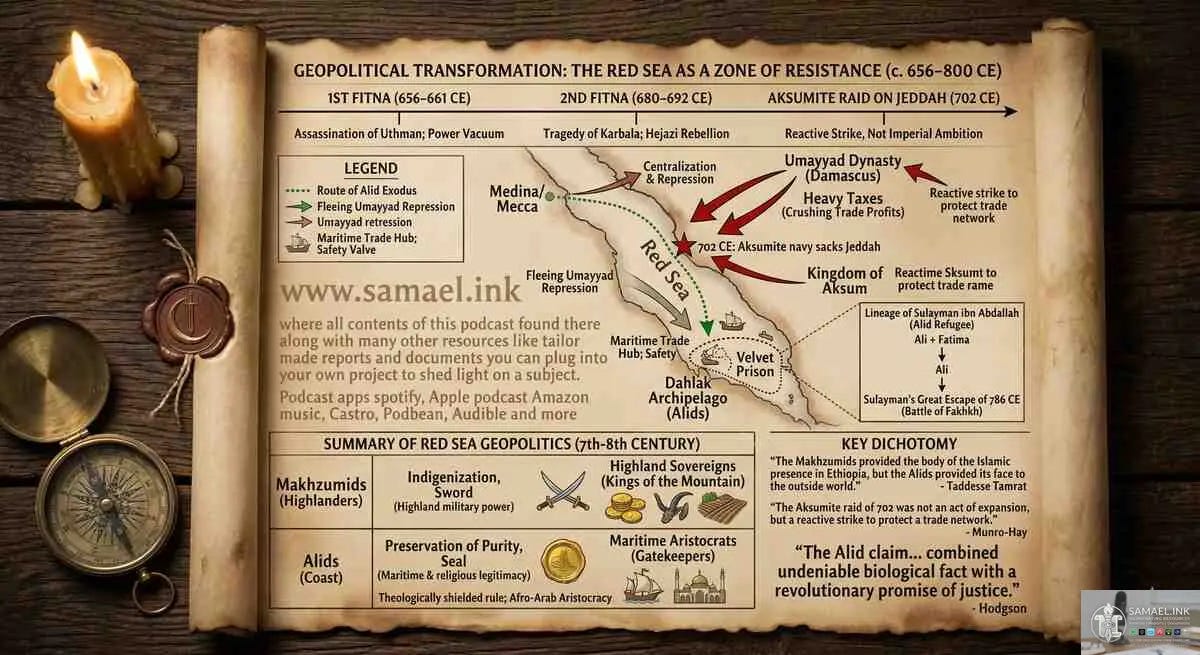
The Second Fitna (680–692 CE) — The World War That Broke the Hejaz
If the First Fitna was a constitutional crisis, the Second Fitna was a world war that directly preceded the 702 CE raid on Jeddah.
The Tragedy of Karbala (680 CE)
When Mu'awiya died, his son Yazid I claimed the throne. Many viewed this hereditary succession as an illegal monarchy. The Prophet's grandson, Husayn ibn Ali, refused to pledge allegiance.
On October 10, 680 CE, Umayyad forces killed Husayn at Karbala. This was not just a military defeat—it was a permanent radicalization of opposition to the Umayyads. The martyrdom of Husayn became the foundational trauma of Shi'a Islam.
The Hejazi Rebellion
Simultaneously, 'Abd Allah ibn al-Zubayr declared himself Caliph in Mecca. For over a decade (683–692 CE), the Hejaz (including Jeddah) existed as a separate state from Syria.
During this period, the Red Sea became what historian Hawting calls a "Zubayrid-Aksumite lake." Trade flourished. The Aksumites and the Hejazi rebels were natural allies—both opposed to Syrian centralization.
The Umayyad Reconquest (692 CE)
The Umayyad general al-Hajjaj ibn Yusuf besieged Mecca, killed Ibn al-Zubayr, and forcibly re-integrated the Hejaz into the Syrian Empire. But victory did not bring peace. It brought repression.
Why the Aksumites Raided Jeddah in 702 CE
Ten years after the Umayyad reconquest, the Aksumite navy struck Jeddah. Why?
The Merchant Discontent
The merchant tribes in Jeddah and Mecca had thrived under Ibn al-Zubayr's "rebel" government, which allowed greater local autonomy. The Umayyads imposed heavy taxes to fund their professional army, crushing the trade profits of the Quraysh and other tribes who had long traded with the Aksumites.
The "Enemy of My Enemy" Dynamic
By 702 CE, the Aksumites viewed the Umayyads as a threat to their maritime dominance. The "Rebel Sharifs" and disgruntled Hejazi merchants likely encouraged the Aksumite raid as a way to weaken Umayyad control over the ports.
As Munro-Hay writes in Aksum: An African Civilisation of Late Antiquity (1991):
"The Aksumite raid of 702 was not an act of expansion, but a reactive strike to protect a trade network that the Umayyad centralists were trying to dismantle."
The Strategic Calculus
The Umayyads responded by occupying the Dahlak Archipelago to serve as a permanent naval watchdog over the African coast. But this move would ultimately backfire.
The Alid Exodus — From Mecca to the Dahlak Archipelago
To understand the long-term consequences of the 702 CE raid, we must follow the refugees.
The Alids: Divine Lineage as Political Weapon
The Alids were the "Legitimists." They believed leadership was not a matter of public consensus but a divine right vested in the family of the Prophet Muhammad. Their name derives from Ali ibn Abi Talib, the Prophet's cousin and son-in-law.
The Kharijites, meanwhile, were the "Radical Egalitarians." They held a meritocratic view: any pious Muslim—even an "Abyssinian slave"—could be Caliph if they were the most virtuous. A Kharijite assassin eventually killed Ali in 661 CE, effectively ending the Rashidun era.
The Flight to the Red Sea
After the Umayyads consolidated power in 661 CE, they viewed both Alids and Kharijites as existential threats. The Dahlak Islands and the coast of the Habash (Ge'ez: ሐበሻ) became the primary "safety valves" for the empire.
If you were a rebel Alid in the 8th century, the safest place to be was a maritime trade hub where the Umayyad cavalry couldn't reach you.
The Suleimaniad Lineage
The Suleimaniads who settled in Dahlak were not random refugees. They were descendants of Sulayman b. Abdallah al-Kamil, a 4th-generation descendant of Ali through the following chain:
Ali ibn Abi Talib + Fatima bint Muhammad
Al-Hasan ibn Ali (d. 670 CE)
Al-Hasan al-Muthanna (d. 715 CE)
Abdallah al-Kamil (d. 762 CE)
Sulayman ibn Abdallah (progenitor of the Suleimaniads)
The Great Escape of 786 CE
The most critical date for this branch is June 11, 786 CE—the Battle of Fakhkh, a failed Alid uprising against the Abbasid Caliphate near Mecca.
Most of the Alid leadership was slaughtered. But two brothers escaped:
As Hawting notes in The First Dynasty of Islam (2000):
"The escape of the brothers Idris and Sulayman from the massacre at Fakhkh in 786 CE effectively exported the Alid revolution from the heart of Arabia to the furthest edges of the known Islamic world."
The Birth of the Dahlak Sultanate
When Sulayman's descendants (the Suleimaniads) established their authority in the 11th century, they weren't just warlords. They were:
Theologically Shielded — Their "Family of the Prophet" status made their rule more legitimate than that of the "usurping" Abbasid governors
Economic Arbiters — They mediated between inland Christian powers (Zagwe/Solomonic dynasties) and the Islamic world
Cultural Hybrids — They married into local elite families (Beja, Agaw), creating an "Afro-Arab" aristocracy
This was not mere survival. This was political innovation.
Conclusion: The Red Sea as a Zone of Resistance
The 702 CE Aksumite raid on Jeddah was not an isolated incident. It was part of a larger pattern: the Red Sea becoming a zone where marginalized Islamic factions could resist central Caliphal authority.
The Fitnas fractured the Islamic world. The Alids fled to the edges. The Aksumites intervened. And from this chaos emerged new political formations—the Suleimaniads, the Dahlak Sultanate, and a centuries-long tradition of Afro-Arab cooperation that defied the simplistic binaries of "Christian Africa" versus "Muslim Arabia."
As Hodgson writes in The Venture of Islam (1974):
"The Alid claim was the most successful political ideology in the history of the early Caliphate precisely because it combined an undeniable biological fact with a revolutionary promise of justice."
The Red Sea was never just a body of water. It was a frontier of ideas, a corridor of resistance, and a crucible for political innovation that continues to shape our understanding of medieval Afro-Eurasian history.
Further Reading
Madelung, W. The Succession to Muhammad (1997)
Hawting, G.R. The First Dynasty of Islam (2000)
Hodgson, M.G.S. The Venture of Islam (1974)
Tamrat, T. Church and State in Ethiopia (1972)
Munro-Hay, S. Aksum: An African Civilisation of Late Antiquity (1991)
This article is part of an ongoing series on Red Sea geopolitics in the early Islamic period. Subscribe for future installments on the Zagwe dynasty, the rise of the Solomonic restoration, and the maritime networks that connected East Africa to the wider Indian Ocean world. Explore parts in this series below. Make sure to check rudimentary level content from HYohannes and use our Google Opal Chatbot to verify some claims you find there. More African history can be found from other authors like isaac Samuel
The Blood of the Highlands: How the Alid Tax Forged the Sword of Adal

TL;DR The year 1063 CE marked a violent rupture in the Horn of Africa, where the fragile peace between the Makhzumi Sultanate and the Zagwe Kingdom shattered under the weight of economic desperation. Driven by the crushing 10% Ushr tax levied by the Alids of Dahlak at the coast, the Makhzumi Malik attempted to bypass this stranglehold by planting fortifi…
The Solomonic Restoration and the Muslim Sword: How Pluralism Shaped Medieval Ethiopia

TL;DR The rise of the Solomonic Dynasty in 1270 CE was not solely a Christian restoration but a complex political maneuver that relied heavily on Muslim military expertise. Yekuno Amlak’s ascent was facilitated by the Wärjih cavalry and defectors from the
The Walashma and the Ethiopian Highlands: From Caravan Enforcers to Rival Sultanates

TL;DR The relationship between the Walashma dynasty and the Zagwe Kingdom during the 12th and 13th centuries represents one of the most consequential yet understudied power dynamics in medieval Horn of Africa history. Initially functioning as commercial middlemen who controlled the caravan trails through the Afar lowlands, the Walashma gradually transfor…
Golden Crosses and Gunpowder: The Great Decoupling of the Horn (15th–17th Centuries)

TL;DR The geopolitical landscape of the Horn of Africa underwent a radical transformation between the 15th and 17th centuries, shifting from a delicate balance of power mediated by physical symbols of sovereignty to a fractured reality defined by foreign military intervention and internal isolation. In the 15th century, the Solomonic Kings maintained th…